
Modi is the first foreign leader to be invited to the palace by the Crown Prince, who appreciated the role played by Indian workers in the development of UAE as a modern nation, ministry of external affairs spokesperson Raveesh Kumar tweeted.

The attack did not result in any human losses, it said, adding that the remnants of the intercepted and destroyed ballistic missiles fell in separate areas around Abu Dhabi.
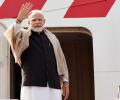
The prime minister's visit will begin from Palestine on February 10 after transiting through Jordan, where he will meet King Abdullah II.
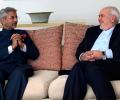
'Tehran,' Foreign Minister Zarif said, 'had expected the Modi government to be "more resilient" in the face of Washington's bullying,' notes Ambassador M K Bhadrakumar.
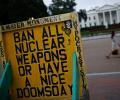
After 20 months of hectic negotiations, Iran and six major powers have reached a historic deal to limit Teheran's nuclear programme in return for lifting of sanctions. Let's understand closely what the deal is all about.
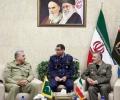
'Tehran senses that the Modi government is inexorably gravitating toward the US-Israeli-Saudi axis, jettisoning India's traditional independent Gulf policies,' notes Ambassador M K Bhadrakumar.
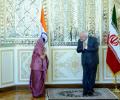
India's low passion, very cautious, relationship with Iran of the last 36 years awaits transformation, says Lieutenant General Syed Ata Hasnain (retd). Prime Minister Modi's visit cannot be a negotiating event; it is a symbolic one to strengthen the politico-diplomatic relationship.

In his address at a ministerial meeting of the SCO in Moscow in the Russian capital, Singh also referred to the Second World War and said its memories teach the globe the 'follies of aggression' of one state upon another that brings 'destruction' to all.
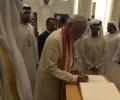
'Here is a man who can steer the country out of the woods. That sense of hope towards Modi was already there. And now that he has actually visited this region, it will go to the next level.' Zafar Sareshwala, a close confidant of Prime Minister Narendra Modi, shares his impressions about the PM's historic visit to the United Arab Emirates.
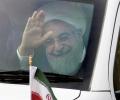
Hassan Rouhani to offer Friday prayers in Hyderabad's Mecca Masjid.

India and Oman have thriving links rooted in centuries old people-to-people exchanges, Modi had said.
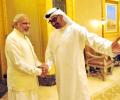
Apart from key bilateral issues, the two leaders also discussed situation in the region, particularly in wake of the increasing threat of terrorism and extremism from various sources including the Islamic State militant group.
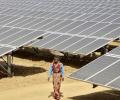
Arunabha Ghosh on why India will increasingly become an energy great power, but not an energy hegemon.

Its promise has fallen short before the onslaught of the votaries of the old order and ruthless extremist forces, notes Talmiz Ahmad.

The PM held wide-ranging talks with the Sultan of Oman and signed eight agreements, including pacts on cooperation in the field of defence, health and tourism.

Indians at large harbour a notion that their country is cherrypicking out of the American basket of goodies, but the policymakers in Delhi and the political leadership are well aware that it can only be a pipe dream since a military alliance with a superpower is a profound irrevocable commitment, observes Ambassador M K Bhadrakumar.

'Qatar has been funding and supporting terrorist organisations.' 'It has used its media to spread lies and create unrest in neighbouring countries.'

The India-Japan joint naval exercises are a strategic signal for China, observes Dr Rajaram Panda.
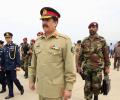
Nawaz Sharif may have permitted the trial of Jaish-e-Mohammed terrorists for the Pathankot attack. But this fell apart because of General Raheel Shareef's keenness to make Kulbhushan Jadhav the centerpiece of global attention. Ambassador G Parthasarthy, a former Indian high commissioner to Pakistan, reveals the Pakistan army chief's gambit against India.

Secretary of State Mike Pompeo said that countries like India, if it gets the exemption, would be asked to bring down their oil imports from Iran to zero in six months' time.

The US intends to break up India's strategic partnership with Russia and to continue to interfere in Indian-Iranian relations, apart from inserting itself into the Sino-Indian bilateral discourse, says Ambassador M K Bhadrakumar, analysing the US defence secretary's visit to India.

Talmiz Ahmad is a former Indian ambassador to Saudi Arabia, Oman and the UAE. In an interview with Aditi Phadnis, he says the disequilibrium in Iraq will continue to prevail. Ahmad also says there are indications that the US is now anxious to avoid intervening militarily in West Asia, and that this is the appropriate moment for Asia to assume responsibility for its own security. Edited excerpts:

'At the very end of his speech, he dealt with the 'small problems' of Indian workers. But these measures did not seem to satisfy those who had expected the prime minister to find solutions for their problems. That the prime minister generally focused on broad policy issues and not on matters of detail left them bewildered,' says Ambassador T P Sreenivasan.
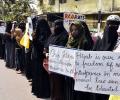
India and Indians can ignore Pakistan, but that cannot be said of other nations in the neighbourhood, where New Delhi's 'Neighbourhood First' policy constantly reverberates. Four of the eight SAARC member-nations are Muslim -- Afghanistan and Pakistan, Bangladesh and the Maldives. The rulers decide the nation's India or anti-India policy in the first two, and street-opinion contributes to the same in the latter two, points out N Sathiya Moorthy.
'If his three priorities are the economy, the economy, the economy, then there is need for a stable region, a stable neighbourhood.'

Jaishankar is the first foreign secretary to head the Ministry of External Affairs as minister.

As the pandemic unfolded, the India-China relationship has come under severe stress. To restore normalcy, agreements between the two countries must be respected scrupulously in their entirety. Where the Line of Actual Control is concerned, any attempt to unilaterally change the status quo is unacceptable, declares External Affairs Minister Dr Subrahmanyam Jaishankar.

India on Wednesday asserted there can be no military solution to the lethal Syrian conflict and societies cannot be "re-ordered from outside" as people have the right to choose their own destiny.

On matters relating to the Diaspora, the Centre needs to call the shots, suggests Ambassador T P S Sreenivasan.
'The ceremony on May 30 is all about Modi and there is the great risk that Imran Khan who is a rockstar among Indians might end up stealing the show,' says Ambassador M K Bhadrakumar.

Iraq is on the verge of collapsing and foreign military intervention is inevitable. But for those who follow the developments in Iraq and the Middle-East will understand the current situation is nothing but a culmination of US and western policies toward the region, says Dr Waiel Awwad
In a clear attempt to allay Russia's apprehensions, Prime Minister Manmohan Singh on Monday said it will remain an "indispensable" partner for India's defence needs even as he underlined that the bilateral ties should adapt to changing times to address challenges.

Diplomats agree that amid stormy relations with China and Pakistan, Modi has posted impressive foreign policy successes, notes Aditi Phadnis.

"Getting straight to business. PM @narendramodi just concluded a fruitful interaction with top energy sector CEOs at a Roundtable meeting in #Houston. Discussion focussed on working together for energy security and expanding mutual investment opportunities between India & US," MEA Spokesperson Raveesh Kumar said in a tweet.

New Delhi and Beijing are the only two regional capitals that have commented on US President Donald Trump's speech on August 21 outlining the way forward in Afghanistan. The Indian foreign ministry statement was effusive in praise, while the Chinese statement has been one of cautious and guarded hope. Delhi has identified itself with Trump's Afghan strategy, whereas the Chinese stance is calibrated -- observant and objective, keeping a distance, says Ambassador M K Bhadrakumar.

'If, as appears to be the case, India is on way to 'mending fences' with China, and China is equally desirous to 'reset' the relationship, this could be a self-reflexive moment in India's positioning vis-a-vis not just the Dalai Lama, but also the Tibetan issue and China as a whole,' points out China expert Alka Acharya.

Modi is likely to seek support of Switzerland and Mexico for India's membership of the 48-member Nuclear Suppliers Group as both these countries are key members of the elite group. The issue is likely to figure during Modi's meeting with Obama in Washington.

'Modi's promise of change during the election campaign was on the domestic front, but his first year in office focused on foreign policy beyond all expectations,' says Ambassador T P Sreenivasan.

As India rises, creating niche areas for itself in the Asian landscape, China and India are bound to step on each other's vital areas of importance, says Srikanth Kondapalli.
 © 2026 Rediff.com - Advertise with us - Disclaimer - Privacy Policy - Sitemap - Feedback - About us - Terms of use - Grievances